
2-Burner vs. 3-Burner vs. 4-Burner Wok Ranges: Which Setup Is Right for You?
Choosing the right wok range configuration is one of the most important decisions when designing or upgrading a commercial Asian kitchen. Burner count directly affects cooking speed, menu execution, kitchen workflow, and long-term return on investment. For restaurant owners, architects, and contractors planning a Chinese or Asian concept, understanding the differences between 2-burner, 3-burner, and 4-burner wok ranges helps ensure the kitchen is built to perform from day one.
At GeneralREQ, we’ve spent decades designing and manufacturing custom wok ranges for kitchens of every size, from compact neighborhood takeout spots to high-volume restaurants running nonstop service. Below, we break down how each configuration performs and how to choose the setup that best fits your operation.
Understanding Wok Ranges and Burners
What Is a Wok Burner?
A wok burner is a high-output gas burner specifically designed to deliver intense, focused heat for wok cooking. Unlike standard range burners, wok burners are engineered to support round-bottom woks, maintain high temperatures during rapid stir-frying, and deliver the heat needed to create wok hei, the signature flavor developed through high-heat cooking.
Commercial wok burners typically operate at significantly higher BTU levels than standard burners and are often paired with custom-built wok ranges that include integrated water wells, backsplashes, and grease management systems.
How Burner Count Impacts Performance
Burner count determines how many dishes can be cooked simultaneously and how efficiently a kitchen can handle peak service. More burners increase output and flexibility but also require more space, stronger gas infrastructure, and greater ventilation capacity. The right balance depends on menu complexity, service volume, and available footprint.
2-Burner Wok Ranges: Compact & Efficient
Ideal Use Cases
2-burner wok ranges are best suited for:
- Small restaurants or takeout-focused operations
- Limited kitchen footprints
- Menus with fewer wok-driven dishes
- Lower to moderate service volumes
They are often chosen for first-time restaurant builds or as secondary cooking stations.
Pros of 2-Burner Wok Ranges
- Smaller footprint, ideal for tight kitchens
- Lower upfront equipment cost
- Reduced gas and ventilation requirements
- Easier integration into existing layouts
For chefs, a 2-burner setup can still deliver excellent results when menu execution is streamlined and timing is well managed.
Cons of 2-Burner Wok Ranges
- Limited capacity during peak service
- Less flexibility for multitasking
- Potential bottlenecks with complex menus
As volume grows, many operators find that 2 burners can quickly become a constraint.
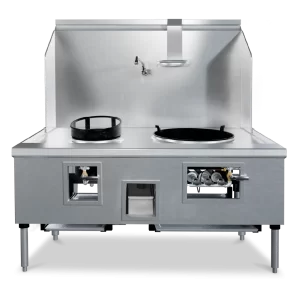
3-Burner Wok Ranges: Balanced Performance
Ideal Use Cases
3-burner wok ranges are a popular choice for:
- Mid-sized Chinese and Asian restaurants
- Growing operations with diverse menus
- Kitchens that need flexibility without excessive space demands
This configuration often represents the best balance between performance and efficiency.
Pros of 3-Burner Configurations
- Improved throughput over 2-burner setups
- Better workflow distribution for chefs
- Flexibility to dedicate burners to specific dishes or techniques
- Strong balance of cost, space, and output
From a design perspective, 3-burner wok ranges integrate well into most commercial kitchen layouts without overloading utilities.
Cons of 3-Burner Configurations
- Larger footprint than 2-burner models
- Higher gas and hood requirements
- May still be limiting for very high-volume service
For many operators, however, these trade-offs are well worth the added capacity.
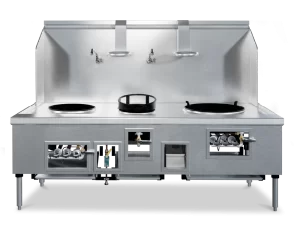
4-Burner Wok Ranges: Maximum Output
Ideal Use Cases
4-burner wok ranges are designed for:
- High-volume restaurants
- Large dining rooms or multiple service periods
- Kitchens with dedicated wok stations
- Menus heavily reliant on stir-fry production
These setups are common in traditional Chinese kitchens and busy urban restaurants.
Pros of 4-Burner Wok Ranges
- Maximum cooking capacity and speed
- Excellent for handling peak rushes
- Allows multiple chefs to work simultaneously
- Supports complex, wok-heavy menus
When properly designed, a 4-burner range significantly increases kitchen efficiency and revenue potential.
Cons of 4-Burner Ranges
- Larger footprint and higher installation cost
- Increased gas line sizing and ventilation demands
- Higher upfront investment
This configuration requires careful planning between designers, contractors, and equipment manufacturers to ensure infrastructure is properly sized.
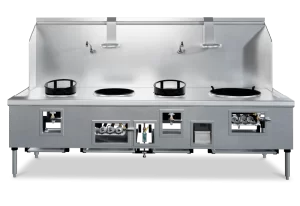
How to Choose the Right Wok Range for Your Kitchen
When selecting a wok range configuration, consider the following:
- Menu requirements: How many wok dishes are prepared simultaneously?
- Service volume: Peak-hour demand is more important than average volume.
- Kitchen space: Measure usable line space, not just total square footage.
- Utilities: Gas supply and hood capacity must support the burner count.
- Staffing: Number of chefs working the wok station at once.
Chefs’ input is critical here, as they understand real-world workflow constraints better than anyone.
Budget Considerations
While 2-burner ranges have the lowest upfront cost, investing in additional burners can reduce labor strain, improve ticket times, and increase long-term revenue. For many operators, a custom-built wok range tailored to their exact needs provides the best return on investment over the life of the kitchen.
Final Thoughts
There is no one-size-fits-all answer when it comes to wok range burner count. The right choice depends on your menu, volume, space, and long-term goals. Whether you’re designing a compact kitchen or a high-output operation, working with an experienced commercial kitchen manufacturer ensures your wok range is built to perform reliably for years to come.
At GeneralREQ, we work closely with restaurant owners, chefs, architects, and contractors to design and fabricate custom wok ranges that fit both the kitchen and the business behind it, delivering durability, efficiency, and lasting value.