
The Difference Between Standard Commercial Burners and High-BTU Wok Burners
When designing a commercial kitchen, especially one centered on Asian cuisine, burner selection is not a minor detail. The difference between a standard commercial burner and a high-BTU wok burner directly impacts cooking speed, food quality, kitchen workflow, and long-term operational efficiency.
For restaurant owners, architects, contractors, and chefs involved in kitchen planning, understanding how BTU output translates to real-world performance is essential. This guide breaks down those differences and explains when high-BTU wok burners are not just beneficial, but necessary.
Understanding BTUs in Commercial Cooking Equipment
What Does BTU Mean on a Gas Stove or Range?
BTU stands for British Thermal Unit and measures the amount of heat a burner can produce. In commercial kitchens, BTU ratings are used as a baseline indicator of cooking power, heat recovery, and the ability to maintain temperature under load.
Higher BTU burners deliver more heat faster, but BTU alone does not tell the full story. Burner design, flame pattern, and heat transfer efficiency all determine how that energy is applied to cookware and food.
Gas Stove BTU vs. Gas Grill BTU
BTU ratings are often misunderstood because they vary by equipment type. A gas grill and a gas stove may have similar BTU numbers, but they apply heat very differently.
- Gas stoves and ranges focus heat upward into cookware for controlled cooking.
- Gas grills disperse heat across a larger surface area and rely on radiant heat.
This distinction is important when comparing standard burners to wok burners, where focused, vertical heat delivery is critical.
Standard Commercial Burners Explained
Typical Burner BTU Output and Use Cases
Standard commercial range burners typically fall within a moderate BTU range designed for versatility. They are well-suited for:
- Boiling, simmering, and sautéing
- General line cooking
- Western and mixed-menu kitchens
These burners are designed to be consistent and controllable, making them ideal for kitchens that require precision rather than extreme heat.
Limitations for High-Heat Cooking
While standard burners are reliable for many applications, they struggle with high-heat techniques like traditional stir-frying. Common limitations include:
- Slower heat recovery when cold ingredients are added
- Inability to maintain oil temperature during rapid cooking
- Reduced capacity to develop wok hei
For menus that rely heavily on wok cooking, these limitations can affect both food quality and service speed.
High-BTU Wok Burners Explained
High BTU Output and Burner Design
High-BTU wok burners are purpose-built for intense heat output and rapid temperature recovery. They often feature:
- Significantly higher BTU ratings than standard burners
- Focused flame patterns that wrap around the wok
- Designs optimized for round-bottom cookware
These burners are commonly integrated into custom wok ranges that include water cooling, grease control, and heavy-duty stainless steel construction.
Why High BTU Matters for Wok Cooking
Authentic wok cooking depends on speed and sustained heat. High-BTU burners allow chefs to:
- Instantly vaporize moisture and oil
- Cook ingredients quickly without steaming
- Maintain consistent heat throughout the cooking process
From a chef’s perspective, this control is essential for flavor development, texture, and consistency during peak service.
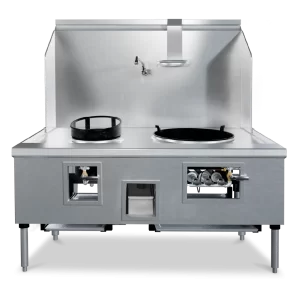
Standard Burners vs. High-BTU Wok Burners
BTU Stove Power and Cooking Performance
The most noticeable difference between standard burners and high-BTU wok burners is performance under pressure. High-BTU burners:
- Recover heat faster
- Handle larger batch sizes
- Support continuous high-volume cooking
Standard burners, while versatile, are not designed for sustained extreme heat or rapid ingredient turnover.
Infrastructure and Ventilation Considerations
Higher BTU output comes with infrastructure requirements. High-BTU wok burners often require:
- Larger gas lines
- Enhanced ventilation and hood capacity
- Proper heat shielding and backsplash design
This is why coordination between kitchen designers, contractors, and equipment manufacturers is critical during the planning phase.
How Many BTUs Do You Need for Wok Cooking?
Commercial Wok Burner BTU Ranges
Commercial wok burners are available across a wide range of BTU outputs, from entry-level systems to high-powered configurations used in traditional Chinese kitchens. The appropriate range depends on:
- Menu complexity
- Volume of wok-fired dishes
- Number of burners operating simultaneously
There is no universal “best” BTU rating, only what is appropriate for the operation.
Choosing the Right BTU Level for Your Menu
A smaller menu with limited stir-fry items may not require maximum output, while a wok-centric menu with continuous service demands higher BTUs to maintain consistency and speed. Chefs’ input is especially valuable here, as they understand how heat translates to execution during service.
Choosing the Right Burner for Your Restaurant
When a Standard Burner Is Enough
Standard commercial burners are often sufficient when:
- Wok cooking is not a primary focus
- The menu emphasizes low to moderate heat techniques
- Space, gas supply, or ventilation is limited
They remain a practical choice for many kitchens when used appropriately.
When a High-BTU Wok Burner Is Required
High-BTU wok burners become essential when:
- Stir-fry is a core part of the menu
- High-volume service is expected
- Authentic flavor and speed are priorities
In these cases, investing in purpose-built wok equipment supports better food quality, smoother service, and stronger long-term returns.
Final Thoughts
Understanding the difference between standard commercial burners and high-BTU wok burners helps ensure kitchens are designed for how they actually operate—not just how they look on paper. The right burner choice supports chefs, protects workflow, and delivers consistency that guests notice.
At GeneralREQ, we work closely with restaurant owners, chefs, architects, and contractors to design and fabricate cooking equipment that aligns with real-world demands, ensuring every burner choice contributes to performance, durability, and return on investment.